
Black specks on a supply register. A musty smell every time the air kicks on. Dark growth around the air handler in the hall closet. Mold in AC vents and air ducts is one of the most common worries in North Alabama homes, and one of the easiest to make worse by accident.
This guide covers why HVAC systems here are prone to it, what EPA says to do (and not do), and an Alabama rule that surprises many homeowners: cleaning HVAC equipment and ducts requires state certification.
Huntsville Mold Experts is a free quote service. We connect Huntsville-area homeowners with independent local mold inspection and remediation companies for free, no-obligation quotes. When a job involves the HVAC system, ask any company you're considering about the certification described below.
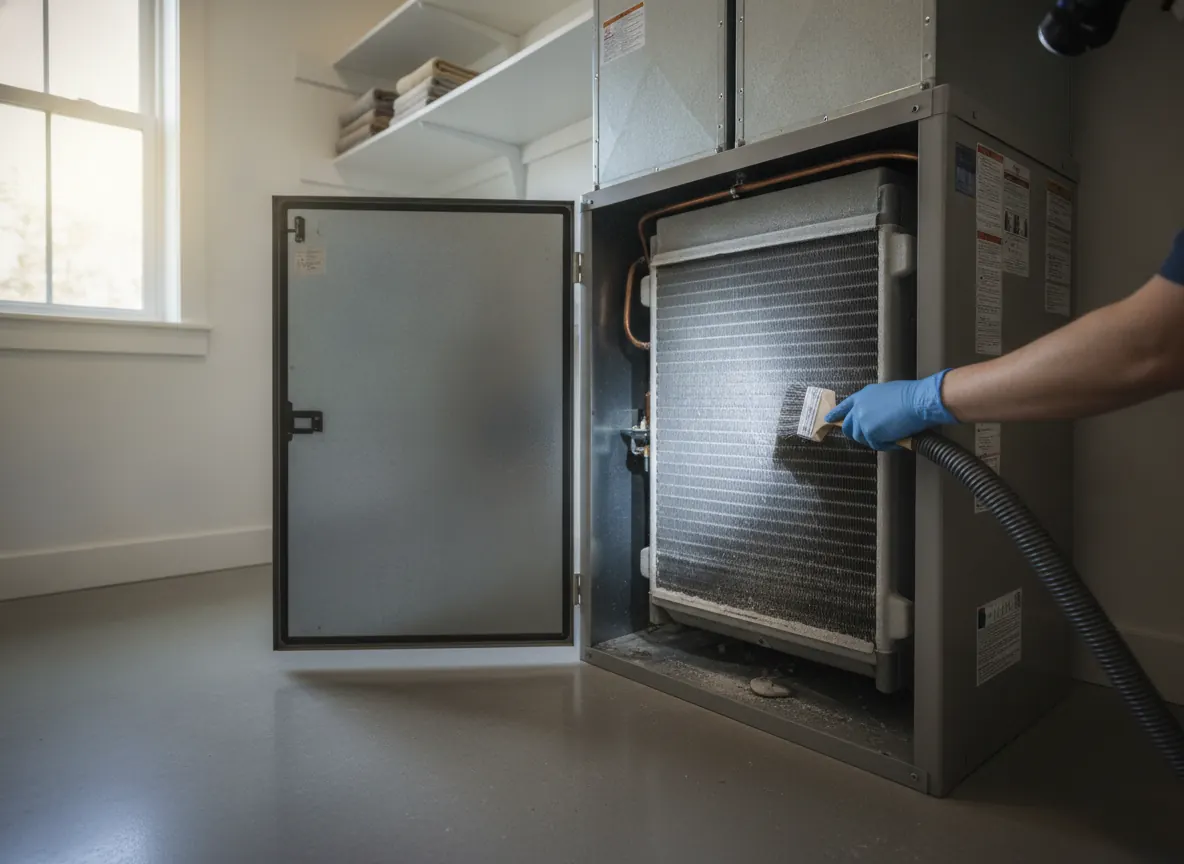
Why AC systems in Huntsville grow mold
Air conditioners pull moisture out of the air, and in a Huntsville summer there's a lot of it. NOAA's 1991–2020 hourly normals for Huntsville International Airport put average dew points at about 66°F in June, 70°F in July and 68.5°F in August, and July's average high is 91.5°F. Muggy air like that condenses on cool surfaces, and few surfaces in a house are cooler than an AC coil and the ducts carrying chilled air. That's general building science rather than a NOAA finding, but it explains why the HVAC system is a common place for moisture to collect.
Moisture plus dust is what mold needs. Places worth checking include:
- The supply registers and grilles, especially where cool air meets warmer, humid room air.
- The air handler cabinet, coil and drain pan.
- Ductwork running through a hot attic or a damp crawl space. See attic mold and crawl space mold and encapsulation.
- Insulation around ducts that has stayed wet from condensation or a roof leak.
Don't confuse dust with mold. Gray buildup on a return grille is often just dust. If you're unsure, a visual inspection by someone who understands HVAC systems is the next step.
What EPA says about mold in HVAC systems
The EPA's homeowner guide, A Brief Guide to Mold, Moisture and Your Home (updated February 2026), gives one clear instruction for HVAC systems:
"Do not run the HVAC system if you know or suspect that it is contaminated with mold - it could spread mold throughout the building."
That is a hard instruction to follow in a Huntsville July, which is one reason to get the system looked at quickly once you suspect a problem rather than waiting for fall.
EPA's other core points apply here too:
- Fix the water. "If you clean up the mold, but don't fix the water problem, then, most likely, the mold problem will come back." With HVAC, the "water problem" is often a drain, a sweating duct or humidity the system can't keep up with.
- Dry quickly. "It is important to dry water-damaged areas and items within 24-48 hours to prevent mold growth."
- Hire for experience. When hiring, "make sure the contractor has experience cleaning up mold."
Alabama requires HACR certification for HVAC cleaning
This is the part most homeowners don't know. Alabama's Board of Heating, Air Conditioning and Refrigeration Contractors (HACR) rule 440-X-3-.02(3) states:
"Certification by the Board is required for work involving air duct cleaning services, filter changing services, test and balance services, and the cleaning of heating, air conditioning or refrigeration equipment or systems."
In other words, cleaning mold from ducts, coils or other HVAC equipment in Alabama is work that requires HACR certification. (The quote comes from the board's Law, Rules and Regulations document dated October 17, 2024.)
That's different from mold remediation in general. ADPH says Alabama has no mold licensing or certification: "Currently, there are no Alabama laws concerning residential or commercial building mold standards or testing requirements, nor is there any contractor accreditation/certification for contractors performing mold testing or remediation activities." So a company can clean mold off a bathroom wall without any state credential, but the HVAC portion of a job falls under HACR. More on that in Does Alabama license mold companies?
What to ask before anyone opens your system
- "Who will clean the HVAC equipment and ducts, and do they hold HACR certification?" Ask for the certification details in writing.
- "What's causing the moisture, and how will that be fixed?"
- "What are you cleaning, what are you replacing, and what's in the written scope?"
- For the rest of the job: ADPH suggests looking for IICRC-certified firms. Ask for training and certifications, insurance, and an HBLB license number for rebuild work over $10,000.
Can I clean the vents myself?
Wiping a removable register cover is household cleaning. Going further into the system is different. HACR certification is required for duct cleaning and for cleaning HVAC equipment, and EPA cautions against running a system you suspect is contaminated. For anything beyond a grille, call a professional. For non-HVAC surfaces, EPA's general rule is that a homeowner can usually handle a moldy area under about 10 square feet; see the EPA 10-square-foot rule.
Do you need air testing for duct mold?
Usually not. EPA says: "In most cases, if visible mold growth is present, sampling is unnecessary," and "No EPA or other federal limits have been set for mold or mold spores." ADPH says: "Testing for molds is not recommended." If you can see growth on the coil or in a duct, the next step is fixing it, not a lab report. If you're curious when testing does help, read Do you need mold testing?
Renting? The AC is the landlord's to maintain
Alabama's landlord-tenant law, Ala. Code § 35-9A-204(a)(4), requires a landlord to "maintain in good and safe working order and condition all electrical, plumbing, sanitary, heating, ventilating, air-conditioning, and other facilities and appliances." If you rent and see mold around vents, report it in writing. Our guide to Alabama landlord mold duties covers the 14-day notice process. This is general information, not legal advice.
Health concerns
ADPH notes that people with asthma, allergies or breathing conditions may be more sensitive to mold, and that people with mold allergies or asthma should not clean moldy materials. If anyone in the home has symptoms you're worried about, talk with a doctor.
Cost
HVAC mold work varies widely with the size of the system, how far the growth has spread and whether ductwork or insulation needs replacing, so an on-site quote is the only reliable number. For context on general mold costs, typical national ranges from This Old House (2026), Fixr (2025) and Bob Vila (2024), estimates, not quotes, put a typical remediation job at $1,200–$3,750 (This Old House average about $2,300) and a mold inspection at $450–$800. The cost guide has the full table.
Frequently asked questions
Is mold in AC vents dangerous?
EPA cautions not to run an HVAC system you know or suspect is contaminated with mold, because it could spread mold throughout the building. ADPH notes that people with asthma, allergies or breathing conditions may be more sensitive to mold. If anyone in the home has symptoms you're concerned about, talk with a doctor, and have the system looked at.
Who can clean mold from air ducts in Alabama?
Under Alabama HACR board rule 440-X-3-.02(3), certification by the board is required for air duct cleaning and for cleaning heating, air conditioning or refrigeration equipment or systems. Ask any company that will clean your ducts, coil or air handler whether the person doing that work holds HACR certification, and get it in writing.
Should I turn off my AC if I see mold in the vents?
EPA's guidance says not to run the HVAC system if you know or suspect it is contaminated with mold, because it could spread mold throughout the building. In a Huntsville summer that's hard, so get the system assessed promptly and ask about a plan that addresses both the growth and the moisture causing it.
Do I need an air test for mold in my ducts?
Usually not. EPA says that in most cases, if visible mold growth is present, sampling is unnecessary, and no federal limits have been set for mold or mold spores. ADPH says testing for molds is not recommended. If growth is visible on the coil or in the ducts, the focus should be cleanup and fixing the moisture.
Get quotes for HVAC mold
If you're seeing or smelling mold at your vents, a free, no-obligation quote request takes about a minute. Mention that the HVAC system is involved so companies know to plan for it. We usually reply the same day. You can also call: Call (727) 300-6656.