
How Mold Quotes and Remediation Work
Huntsville Mold Experts is a free quote service, not a mold company. We connect Huntsville-area homeowners with independent local mold inspection and remediation companies for free, no-obligation quotes. Here is our part, and what a professional mold job typically involves.
Get a Free QuoteOur part: getting you quotes
We do not inspect, test or remediate anything ourselves. The company you choose does the work and contracts with you directly.
1. You share the details
Fill out the free quote form or call Call (727) 300-6656. Tell us where you see or smell mold (crawl space, attic, basement, walls or around the air handler), roughly how big the area is, and whether there was a leak, flash flood or storm. Photos help if you have them.
2. Local companies follow up
Your request goes to independent mold inspection and remediation companies that serve your area, from Huntsville and Madison to Athens and Decatur. We usually reply the same day.
3. You compare and decide
Companies typically schedule a visit, look at the space and give you a written scope and price. Compare scopes line by line using our cost guide. You choose which company to hire, if any, and there is no obligation.
Before you hire: questions to ask
The Alabama Department of Public Health says there is no state accreditation or certification for contractors performing mold testing or remediation. ADPH suggests looking for IICRC-certified firms; ask any company for its training and certifications, insurance, and an HBLB license number for rebuild work over $10,000. Also ask:
- What is causing the moisture, and is fixing it in your scope or someone else’s?
- How will you contain the work area, and which rooms are affected?
- Which materials will be removed, and which will be cleaned?
- Does the job involve HVAC equipment or ducts? Alabama requires HACR certification for that work.
- Could the home have asbestos or lead paint in materials that will be disturbed?
- How will you show the job is finished, and can an independent party check it?
Our article Does Alabama license mold companies? goes deeper. This is general information, not legal advice.
What mold remediation typically involves
Every company works a little differently and every house is different, but most professional jobs follow the same broad sequence, built around EPA and ADPH guidance. Knowing it helps you read a quote and spot anything missing.
Assessment and finding the moisture source
The company you hire typically looks at the affected area, checks moisture with a meter and asks about leaks, floods or storms. The EPA says that in most cases, if visible mold growth is present, sampling is unnecessary. Inspection may be suggested when mold is hidden or suspected; see mold inspection and testing.
Fixing the water problem
The EPA puts it plainly: if you clean up the mold but don’t fix the water problem, the mold problem will most likely come back. Leaks, grading, gutters or humidity get addressed, sometimes by a roofer, plumber or HVAC contractor. In Huntsville’s summer, average July dew points near 70°F (NOAA 1991–2020 normals) make humidity control a common part of the plan, especially in crawl spaces.
Containment
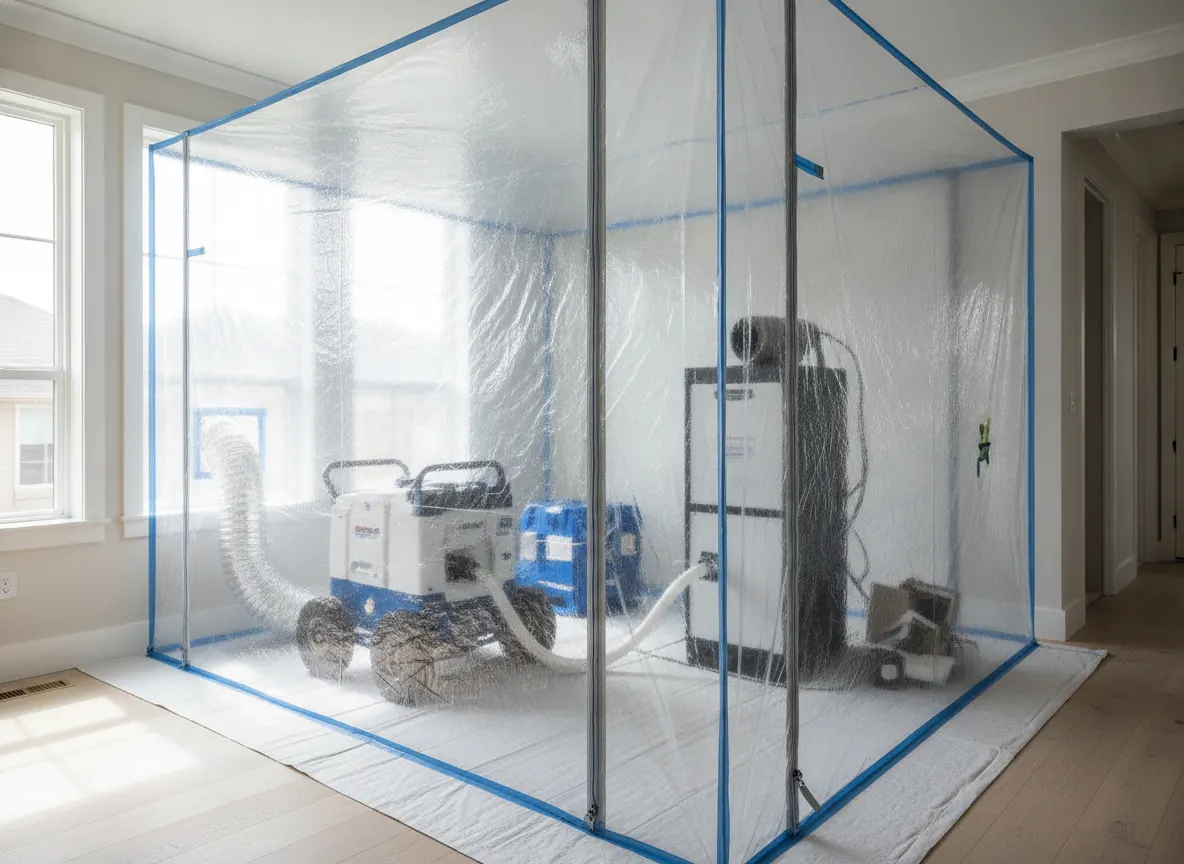
For larger areas, the work zone is usually sealed with plastic sheeting and a zipper door, and air scrubbers filter the air so spores are not carried into clean rooms. The HVAC system is often shut off; the EPA advises not running it if you know or suspect it is contaminated with mold.
Removal and cleaning
Moldy porous materials such as drywall, insulation and carpet are typically cut out and bagged. ADPH says materials that are wet and cannot be thoroughly cleaned and dried should be discarded. Framing, decking and other hard surfaces are cleaned.
Drying and dehumidifying
Remaining materials are dried before anything is closed up. ADPH notes that drying can take several weeks and that microbial growth continues as long as humidity is high, so dehumidifiers often run during and after the job.
Verification
The area is checked to confirm visible mold is gone and materials are dry. Some homeowners hire an independent clearance check at this stage; air sampling typically runs about $250–$350 (Bob Vila, 2024). Note the EPA says no federal limits have been set for mold or mold spores.
Rebuild
New drywall, insulation, flooring or paint goes back in. Under Alabama’s Home Builders Licensure Board law, residential repair or improvement work over $10,000 (roofing over $2,500) generally requires an HBLB license, so ask who holds it. Older homes may raise asbestos or lead-paint rules when materials are disturbed.
After a flood or storm: start drying now
You don’t have to wait for quotes to protect your home. The EPA says it is important to dry water-damaged areas and items within 24–48 hours to prevent mold growth, and ADPH advises beginning to dry wet materials as soon as possible. Huntsville has seen how fast this matters, from the 1999 Aldridge Creek flash flood that reached about 300 homes and businesses to the April 2011 tornado outbreak that left many Tennessee Valley residents without power for five to seven days. See water and storm damage mold for more, and talk to a doctor if you have health concerns.
Seeing or smelling mold? Get a clear plan.
Free, no-pressure quotes across Huntsville, Madison, Decatur, Athens and North Alabama.