
If your home sits over a crawl space, you may have heard that crawl space mold is "just normal" in North Alabama, or that every crawl space needs to be encapsulated. Neither claim holds up as a blanket rule. This guide looks at why crawl spaces in the Huntsville area can stay damp, what the published numbers do and do not say, the signs worth checking, and how to decide between fixing a moisture problem, cleaning up mold and full crawl space encapsulation.
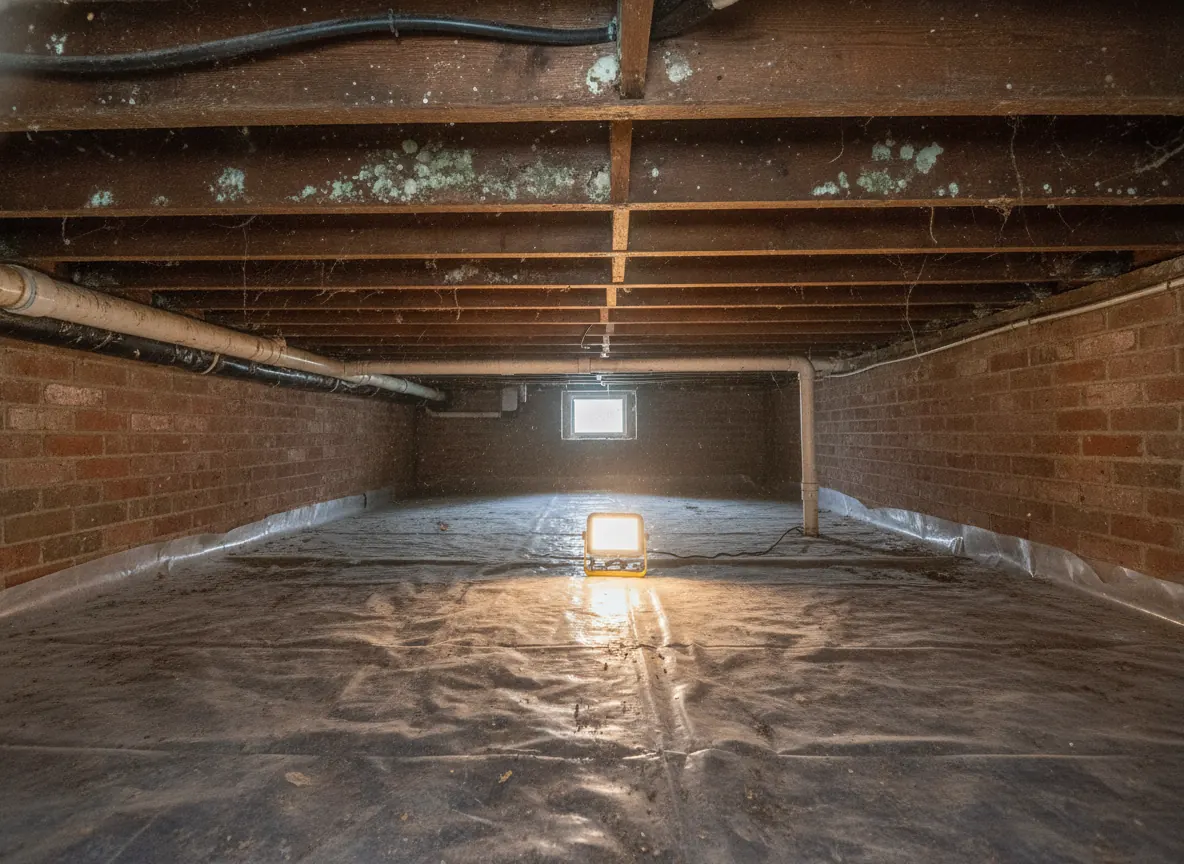
How common are crawl spaces around Huntsville?
There is no study that counts how many North Alabama homes sit on crawl spaces versus slabs, and the Census does not track foundation type for existing homes. What we do have is a regional figure for new construction. According to the National Association of Home Builders, using Census Survey of Construction data, 42.2% of new single-family homes started in 2021 in the East South Central division (Alabama, Kentucky, Mississippi and Tennessee) had a crawl space, and 39.6% were built on slabs. Nationally, crawl spaces are far less common: roughly 9–11% of new homes in recent years.
NAHB also notes that this region has "historically led in crawl space usage" but has seen "noticeable decreases." So the honest takeaway is that crawl spaces are much more common in this part of the country than nationally, not that any particular share of Huntsville homes has one.
Why crawl spaces in North Alabama stay damp
Several local conditions work together:
- Muggy summers. NOAA 1991–2020 normals for Huntsville International Airport put the average dew point near 66°F in June, 69.9°F in July and 68.5°F in August. When that humid air reaches cooler surfaces such as framing, ducts or pipes under the house, it can condense (that last part is general building science, not a NOAA finding).
- Plenty of rain, mostly in winter and spring. Huntsville averages 54.29 inches of precipitation a year. The wettest months are December (5.87 in.), March (5.39 in.) and February (5.11 in.), so soil around a foundation is often wettest in the cooler months.
- Drainage problems outside the floodplain. The City of Huntsville says that between major floods, over 90% of drainage complaints come from residents outside the floodplain, many on the sides of local mountains. Water under a house is not only a floodplain issue.
- Limestone terrain. Much of the area sits on limestone, and Big Spring downtown is a karst spring. It is reasonable to infer that groundwater moving through rock and soil can show up as seepage in some crawl spaces and basements, though no source ties karst directly to mold.
Do most crawl spaces have mold?
There is no reliable data to say that most crawl spaces in the area, or anywhere, have mold. What the EPA does say is that mold needs moisture, and that "If you clean up the mold, but don't fix the water problem, then, most likely, the mold problem will come back." A dry crawl space is much less likely to have a mold problem than one with standing water, wet soil, plumbing leaks or condensation.
So rather than asking whether crawl space mold is normal, ask whether your crawl space is wet, and why.
Signs worth checking
- A musty smell in the house, especially near floor vents or after rain
- Visible growth or staining on joists, subfloor or the sill plate
- Standing water, wet soil or puddles on an old vapor barrier
- Water beading on ducts or pipes in summer
- Sagging or torn insulation between floor joists
- Soft or cupping wood floors above the crawl space
If you go in to look yourself, take a flashlight and phone camera, and skip it if you have asthma or a mold allergy. ADPH says people with mold allergies or asthma should not clean moldy materials.
Will a crawl space dry out on its own?
Sometimes a one-time event, like a burst pipe that is quickly fixed, can dry out with ventilation and time. But if the moisture source is ongoing (poor grading, gutters that dump next to the foundation, groundwater, humid air condensing on cool surfaces), the crawl space will usually stay damp until that source is dealt with. The EPA says "It is important to dry water-damaged areas and items within 24-48 hours to prevent mold growth," and ADPH notes that drying "could take several weeks, and growth of microorganisms will continue as long as humidity is high."
Your options, from smallest to largest
1. Fix the water source
Gutters, downspout extensions, grading and plumbing repairs come first. Without them, any cleanup or encapsulation is fighting the same water.
2. Crawl space mold remediation
If growth is present on framing or subfloor, remediation companies typically contain the area, remove or clean affected materials, and dry the space. Our crawl space mold and encapsulation page walks through what that usually involves.
3. Vapor barrier and dehumidifier
A ground vapor barrier slows moisture rising from the soil. A crawl space dehumidifier controls humidity in the air. These are often paired.
4. Full crawl space encapsulation
Encapsulation generally means sealing the floor and walls with a heavier liner, closing vents and conditioning or dehumidifying the space. It is the largest option and is not automatically the right one; it makes the most sense when humidity and condensation, not just a leak, are driving the problem.
Typical costs
These are typical national ranges from This Old House (2026), Fixr (2025) and Bob Vila (2024) — estimates, not quotes. Your price depends on size, access, how much material is affected and what the moisture fix involves.
| Item | Typical range |
|---|---|
| Crawl space mold remediation | $500–$2,000 |
| Crawl space encapsulation | $1,500–$15,000 (avg about $5,500; 1,000 sq ft about $3,000–$7,000) |
| Crawl space dehumidifier, installed | $800–$2,000 |
| Mold inspection | $450–$800 (Bob Vila: $299–$1,014, avg about $656) |
For whole-house and room-by-room figures, see the mold remediation cost guide. If a combined contract includes rebuild work like new subfloor or framing and runs over $10,000, Alabama's Home Builders Licensure Board rules generally apply; our Alabama mold law guide explains. This is general information, not legal advice.
Can a crawl space affect your health?
We do not give medical advice. The EPA and ADPH both note that some people, including those with allergies, asthma or other breathing conditions, may be more sensitive to mold. If you have health concerns, talk with your doctor.
Questions to ask before you sign
- Where is the moisture coming from, and does this quote fix it?
- Is encapsulation necessary here, or would drainage plus a vapor barrier do?
- What is included: liner thickness, wall coverage, vents, dehumidifier, drain?
- Who maintains the dehumidifier, and what does that cost?
- What training, certifications and insurance does the company carry? ADPH suggests looking for IICRC-certified firms; ask any company for its training and certifications, insurance, and an HBLB license number for rebuild work over $10,000.
Not sure whether you have mold at all? Our post on whether you need mold testing explains what EPA and ADPH recommend.
Get crawl space quotes
We connect Huntsville-area homeowners with independent local mold inspection and remediation companies for free, no-obligation quotes. Comparing two or three written scopes is one of the easiest ways to see whether encapsulation is being recommended for good reason. Request free quotes; we usually reply the same day.
Frequently asked questions
Do most crawl spaces in North Alabama have mold?
No reliable data says so. What is known is that crawl spaces are common in the region: NAHB reports 42.2% of new homes started in 2021 in Alabama's four-state division had one. Mold needs moisture, so a dry crawl space is much less likely to have a problem. Check for standing water, condensation and musty odors rather than assuming mold is present.
Is crawl space encapsulation worth it in Huntsville?
It can be when humidity and condensation keep a crawl space damp, which Huntsville's summer dew points near 66–70°F can encourage. It is not automatically needed. Fix drainage and leaks first, then compare quotes for a vapor barrier, a dehumidifier and full encapsulation. Typical national ranges run $1,500–$15,000, averaging about $5,500, as estimates.
Will a damp crawl space dry out on its own?
Sometimes, after a one-time leak that is fixed quickly. If moisture keeps coming from poor grading, gutters, groundwater or humid air, the space usually stays damp until that source is addressed. EPA advises drying water-damaged materials within 24–48 hours, and ADPH notes microbial growth continues as long as humidity stays high.